

COMPANY
Integrated Pathology Solutions (IPS)
WEBSITE
www.hdft.nhs.uk/services/pathology
INDUSTRY SECTOR
Health Care
NLR PROGRAMMES
Organisation Programmes
“I was struggling with one of the Biochemistry sites and knew something wasn’t right, though I couldn’t identify the cause. Once I joined ther sessions, it immediately brought clarity and helped everything fall into place.”
Chemistry Clinical Director, IPS
From Three Organisations to One Leadership Team
A two-and-a-half-year partnership with an NHS diagnostics network in Yorkshire, coached by New Level Results Coach, Lynda Fussell

There’s a common assumption that if you bring organisations together, collaboration follows naturally. In reality, it rarely does.
Each organisation carries its own history, culture and pressures. Every leader is responsible for their own patch, while also being asked to think beyond it. Everyone wants to collaborate – but the daily reality keeps pulling people back to their own immediate priorities.
Integrated Pathology Solutions (IPS) was no exception. Set up to deliver pathology services across three NHS Trusts in West Yorkshire (members of West Yorkshire Association of Acute Trusts), IPS had already achieved something significant: exceptional technical expertise, and dedicated professionals delivering vital diagnostic services for thousands of patients every day.
The challenge was never capability. It was how to create the leadership conditions that would let a network become more than the sum of its parts – while workforce pressures, a major new digital system, rising demand and tightening budgets carried on regardless.
The real question underneath it all: how do leaders from three different organisations learn to think like one leadership team, without losing the identity of the organisations they represent? No single workshop was ever going to answer that.

Clarity and a Curve one page plan
It would have been easy to start by writing a strategy. Instead, Lynda started somewhere much simpler: People. Relationships. Trust. Alignment was key and began through creating a team one page plan.
Over the following months this methodology gave Lynda and the leaders a regular space to step away from operational pressure and think differently – not just about performance, but about themselves. How they communicated. How they responded under pressure. What accountability really looked like. How trust gets built.
Some of these conversations were uncomfortable. Some challenged assumptions people had held for years. Sometimes they simply gave leaders permission to stop firefighting long enough to think.
Gradually, something shifted. People became more open. Conversations became more honest. Leaders started asking each other for support, rather than working in isolation. Different opinions stopped being barriers and started being useful.
That comment captures something important: the common vision came after the relationships. Not before. One clinical director recalled a specific moment where that support made a tangible difference to a service under strain:
As trust grew, the conversation shifted from ‘what do I need to do?’ to ‘what do we need to do?’. Accountability, empowerment and collaboration became a shared language, embedded through the network’s own IPS ‘HEART’ values and reflective practice in real time by utilising The Curve® methodology.
“Throughout the coaching journey there is better clarity of the IPS organisational structure, which has improved decision making and outcomes – and better engagement between cross-site teams.”
Clinical Biochemistry Section Manager, IPS

The timing of this work was rarely easy. Throughout the partnership, IPS continued navigating major organisational change, and the unexpected kept arriving – new priorities, new pressures, new demands that could easily have derailed a long-term programme.
However, something different had taken root. Rather than constantly reacting, the leaders increasingly returned to shared team principles. This gave them a common language. They understood one another better, through creating space to think before acting.
That observation says as much about the maturity the leadership team had reached as it does about the programme itself.
The clearest sign of progress came during the annual strategy sessions, where the conversation itself had changed. Leaders were no longer just discussing operational issues – they were asking what IPS should become, what culture would get them there, and what would make the biggest difference.
At this stage in the partnership, the leadership team has built a shared vision for IPS through to 2031, but the more striking evidence sits in the NHS’s own independent staff survey data, which shows the same shift the leadership team describe.

Across the network, the indicators most closely tied to leadership and culture – having a voice that counts, feeling part of a team, engagement and morale – all moved upward. At Airedale and Bradford, every one of the four improved. At HDFT, something even more telling happened.
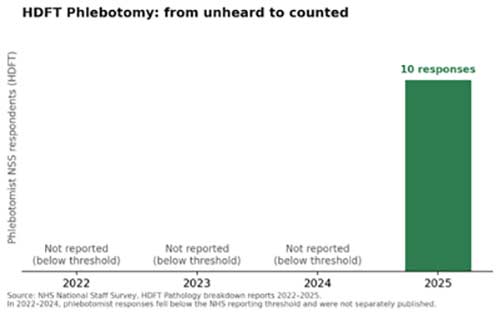
For the first time since records began, enough of the HDFT Phlebotomy team responded to the survey to be counted at all. That’s a real leadership outcome in its own right – a team that had never been heard, being heard. Their answers were, honestly, less positive than the rest of the network on several measures, which briefly pulled HDFT’s average down even as every other team improved. That’s not a footnote to hide; it’s exactly why this kind of work has to keep going – and among the network’s continuing teams, culture indicators rose just as strongly as at Airedale.
The same story shows up question by question. Among Blood Sciences and Microbiology colleagues, the proportion who feel safe to speak up about their concerns rose steadily from 2022 to 2025, and the proportion happy with the standard of care their service provides rose sharply – up to 92% in Blood Sciences, from 74% the year before.
Leaders also describe a quieter but significant shift in how the network handles long-term sickness absence and retention. Rather than letting repeat absence patterns run unaddressed – with the strain always landing on whoever’s left at work – managers now hold earlier, more confident conversations: about what someone needs to return well, and, sometimes, honest conversations about whether a role is still the right fit. Two senior specialists whose performance and wellbeing had been under serious strain, and who were seriously considering leaving, have stayed – with a clear and sustained turnaround in both, following direct coaching support and stronger line management conversations throughout the programme.
Every partnership, network and collaborative, faces some version of this challenge. Structures can be designed. Governance can be agreed. Strategies can be written. None these, on its own, creates collaboration.
Collaboration is built by leaders who trust each other enough to have honest conversations, make shared decisions, and stay committed to a common purpose – even when their own organisations are under pressure. Over two and a half years, IPS showed what is possible when targeted investment is made in developing a strong leadership culture. The NHS’s own data backs this up what its leaders describe. The result wasn’t just a stronger leadership team. It was a stronger, more honest, more resilient network.
“Personally, I have much more assurance of the high-quality work done by IPS, which enables me to articulate and evidence this to the IPS Board. The improved interpersonal relationships of the SLT and forming a common vision was also a clear outcome.
Seeing the leadership development of SLT colleagues (myself included) has been very evident and demonstrates the importance of supporting those in leadership roles in their continued development through high impact coaching like this. Appreciating that what is effectively a culture change takes time and determination, and that “curve balls”, although common, can’t deflect from the ultimate goal.”
Medical Director, IPS/ILS
New Level Results has created the Team Curve® to support teams achieve the results they want. It is a simple one page plan, yet the most powerful approach to creating team effectiveness. We have always believed that culture change can be commercialised and is then demonstrated in bottom line productivity.

